|
Subscriber First Name ͏ ͏ ͏ ͏ ͏ ͏ ͏ ͏ ͏ ͏ ͏ ͏ ͏ ͏ ͏ ͏ ͏ ͏ ͏ ͏ ͏ ͏ ͏ ͏ ͏ ͏ ͏ ͏ ͏ ͏ ͏ ͏ ͏ ͏ ͏ ͏ ͏ ͏ ͏ ͏ ͏ ͏ ͏ ͏ ͏ ͏ ͏ ͏ ͏ ͏ ͏ ͏ ͏ ͏ ͏ ͏ ͏ ͏ ͏ ͏ ͏ ͏ ͏ ͏ ͏ ͏ ͏ ͏ ͏ ͏ ͏ ͏ ͏ ͏ ͏ ͏ ͏ ͏ ͏ ͏ ͏ ͏ ͏ ͏ ͏ ͏ ͏ ͏ ͏ ͏ ͏ ͏ ͏ ͏ ͏ ͏ ͏ ͏ ͏ ͏ ͏ ͏ ͏ ͏ ͏ ͏ ͏ ͏ ͏ ͏ ͏ ͏ ͏ ͏ ͏ ͏ ͏ ͏ ͏ ͏ ͏ ͏ ͏ ͏ ͏ ͏ ͏ ͏ ͏ ͏ ͏ ͏ ͏ ͏ ͏ ͏ ͏ ͏ ͏ ͏ ͏ ͏ ͏ ͏ ͏ ͏ ͏ ͏ ͏ ͏ ͏ ͏ ͏ ͏ ͏ ͏ ͏ ͏ ͏ ͏ ͏ ͏ ͏ ͏ ͏ ͏ ͏ ͏ ͏ ͏ ͏ ͏ ͏ ͏ ͏ ͏ ͏ ͏ ͏ ͏ ͏ ͏ ͏ ͏ ͏ ͏ ͏ ͏ ͏ ͏ ͏ ͏ ͏ ͏ ͏ ͏ ͏ ͏ ͏ ͏ ͏ ͏ ͏ ͏ ͏ ͏ ͏ ͏ ͏ ͏ ͏ ͏ ͏ ͏ ͏ ͏ ͏ ͏ ͏ ͏ ͏ ͏ ͏ ͏ ͏ ͏ ͏ ͏ ͏ ͏ ͏ ͏ ͏ ͏ ͏ ͏ ͏ ͏ ͏ ͏ ͏ ͏ ͏ ͏ ͏ ͏ ͏ ͏ ͏ ͏ ͏ ͏ ͏ ͏ ͏
Dear Subscriber First Name,
|
|
This year, my work has taken longer to make than usual. Between moving studios, changing routines, and everything life has thrown my way, the pace has shifted, but my practice has remained the same. I lose myself in historical myths, magical realism, and oral histories. My desk is stacked with handwritten notes, sketches full of fantasies, and worlds I escape to, pages of references that slowly find their way into my paintings. Some ideas stay with me for years before they finally appear in a piece, while others arrive unexpectedly through a sentence in a book, a conversation, or something I can't stop thinking about.
|
|
Lately, my copy of Introducción al Pasado Aborigen by Luis Duque Gómez has rarely left my desk. I've been returning to it while researching symbols that I sculpt into my paper mache frames and incorporate throughout my work. |
|

|
|
|
|
The studio is usually either completely silent, or filled with a playlist I've made for whatever painting I'm working on. This year, songs like "Ophelia" by Pink Pantheress and the album “Rhapsody In White” by The Love Unlimited Orchestra became part of the foundation for one of my newest paintings, and, as always, I'll share the playlists that accompanied these new works while they were being made with you below.
|
|
While I was in my residency in the Bronx, the legendary Dr. Drums gifted me a keyboard, and I've slowly been teaching myself piano. It's become a way to begin my mornings or end long nights in the studio whenever I need to step away from a painting and let my mind wander. So far, I've been learning "Antología" by Shakira and "Sauvignon Blanc" by Rosalía. Next on the list is D'Angelo.
|
|
|
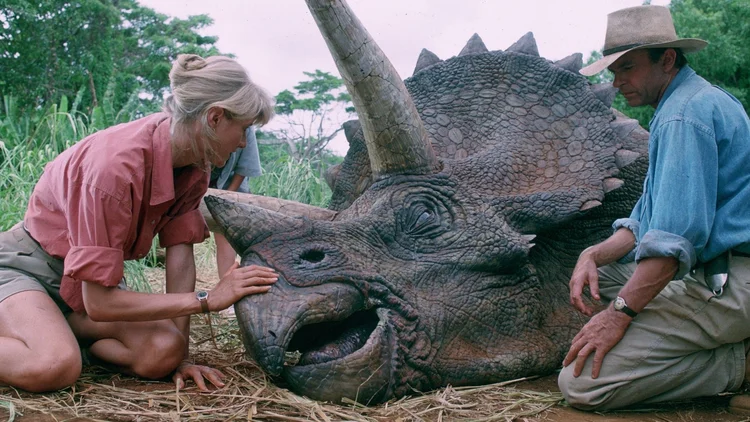
Outside the studio, I watched Jurassic Park (all three) for the very first time, and I finally understand why everyone loves them. |
|
|
|
|
This summer, I am showing Falling From Height (Ophelia) at Hashimoto Contemporary Gallery and ¿Quién Viene A Rescatar Los Ángeles Heridos? (La Flor Que Carga Alma De Un Muerto) at 163 Bowery Studio. Both pieces come from a body of work I have been developing around grief, love, loss, survival, and the invisible wounds we carry. They are connected through questions that have followed me for years, What happens when the thing we loved was never a place we could actually arrive at? Who comes to save the person who has always been strong? What happens when we realize we have been grieving something that may have never fully existed? 🐆🦂🌙🦋🐊
|
|
|
'Falling From Height (Ophelia)' |
|
|
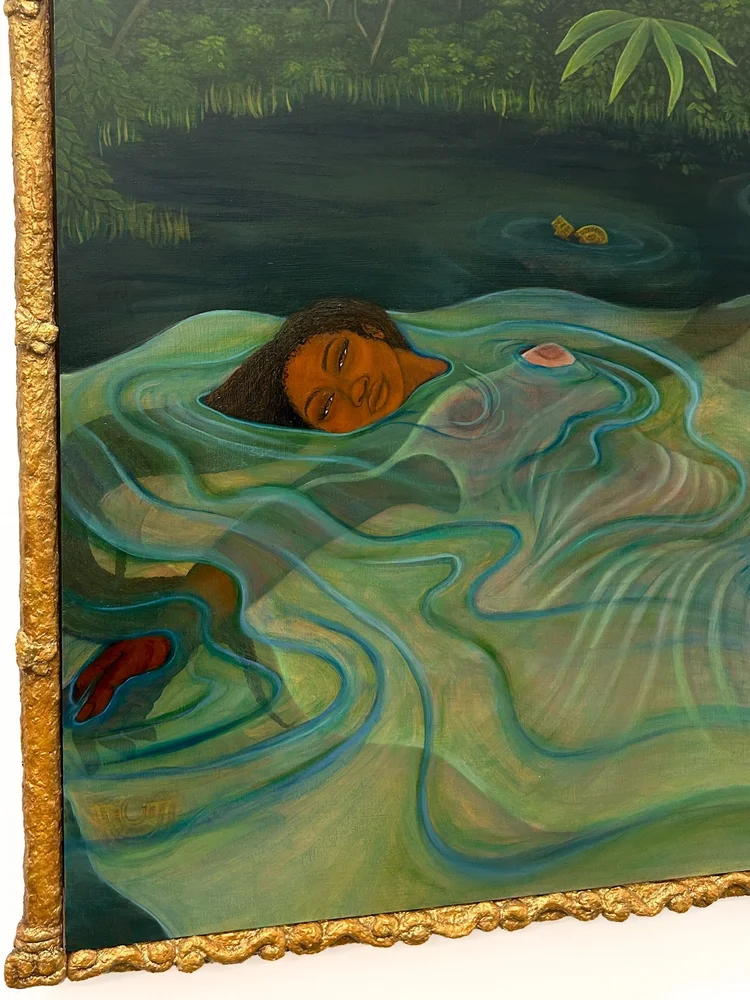
Falling From Height (Ophelia) was born from my own experiences with love, heartbreak, and the psychological unraveling that can happen when the love we believe in suddenly disappears. The painting follows the emotional state of loving someone so deeply that you begin to lose yourself. It explores the manic highs of being chosen, the confusion of abandonment, and the grief of questioning whether love was ever real.
|
|
Through the figure of Ophelia from Shakespeare’s Hamlet, the work reflects on a woman who reaches an emotional height through love, only to be abandoned and left to fall into madness. After Hamlet forgets her, Ophelia’s story ends in mystery when she is found drowned. Whether she fell from a height, chose her own death, or was pushed, her heavy dress weighed her down to drown, becoming a symbol of the weight of love, expectation, and the impossible burden placed upon women, who are so often left to carry the consequences of men's violence, emotional instability, and unhealed wounds. |
|
|
The painting also carries the story of Cuban artist Ana Mendieta, whose life and death remain surrounded by questions of love, power, and violence. Mendieta’s relationship with artist Carl Andre was marked by rumors of emotional and physical abuse, and after an argument in their New York apartment, she fell from the 34th floor window of their building. While Andre claimed she jumped, many of those close to Mendieta have continued to question the circumstances of her death, believing he pushed her. Her story reflects the fear of being consumed by another person’s shadow, especially when a woman’s voice and artistic power are threatened by the person closest to her, the man closest to her. |
|
|
|

|
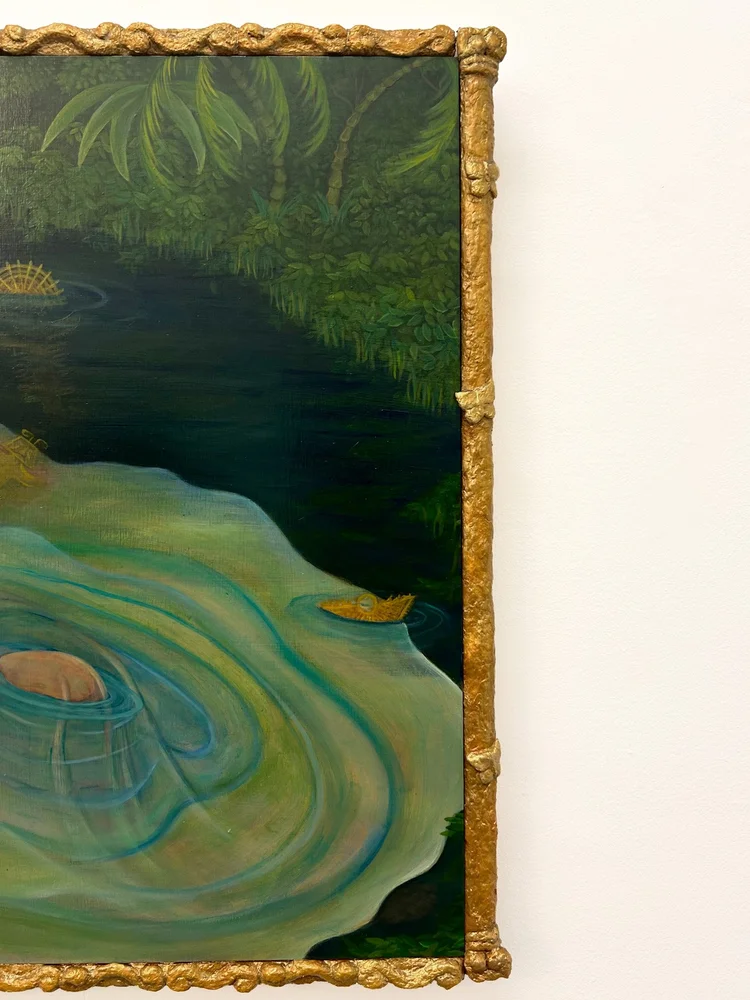
The final story woven into this work comes from the legend of El Dorado and the Muisca people. According to the legend, the chief of the Muiscas had a wife and child, the chief was known to have many secret lovers and was no longer treating his wife right. She found a lover of her own and the chief killed him and fed his wife his heart. The wife of the Muisca chief, unable to bear the pain caused by betrayal and loss, entered the waters of the lagoon with her daughter and disappeared beneath the surface. The chief, devastated by grief, began offering gold and emeralds into the water to honor her, creating the ritual that would later inspire Spanish colonizers’ obsession with finding the mythical city of gold. Their search became another story of desire turning into madness, a pursuit of something imagined, something that perhaps never existed. |
|
|
The sculpted paper mache frame extends these stories beyond the painted surface, my frames have become vessels carrying stories. Drawing from Chami, Tairona, and Kogi visual traditions, I incorporated the symbol of marriage and commitment, reflecting both the promises we make to one another and the bonds that continue to shape us long after relationships end. Throughout the frame, spirals appear as symbols of the shaman in ecstatic flight, representing dreaming beyond the visible world, spiritual transformation, and the psychological spaces we enter through love, grief, memory, and longing. |
|

|
|
|
Through these stories, Falling From Height (Ophelia) examines the spaces between love and illusion, devotion and obsession, memory and disappearance. The title plays with the dual meaning of falling: falling in love and falling from a height to your death. To fall in love is to surrender, to allow yourself to be lifted by another person, to believe in the world they create with you. But the higher we rise into that fantasy, the further the fall can become when the illusion breaks. The painting explores the emotional descent that follows when love transforms into abandonment, when devotion becomes obsession, and when the person you believed would protect you becomes the source of your grief. It examines the feeling of being so deeply in love that losing that love feels like losing your own sense of reality. 🐆🦂🌙🦋🐊
|
¿Quién Viene A Rescatar Los Ángeles Heridos?
(La Flor Que Carga Alma De Un Muerto) Who Saves The Wounded Angel? (The Flower That Carries The Soul Of The Dead) |
|

|
|

|
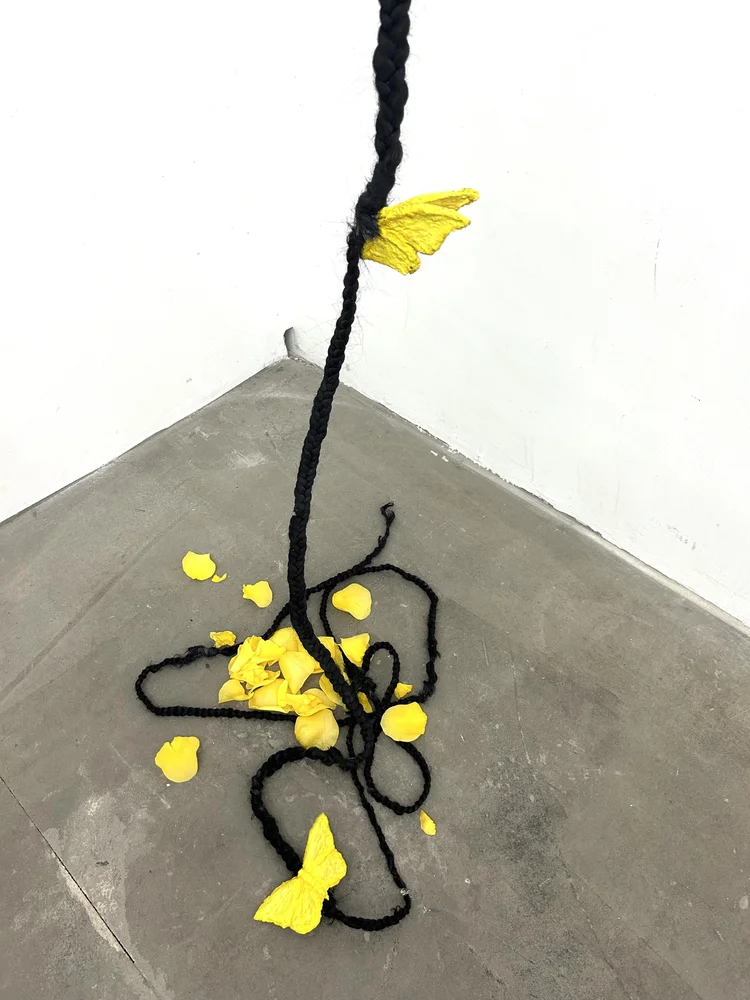
This piece imagines a long braid of hair descending from the sky like a rope dropped down to save you. Three yellow butterflies travel upward along the braid, guiding you toward the heavens. I question who comes to save the wounded angel because I have always wondered who comes to save the strongest person, the resilient person, the person who has always helped others, carried responsibilities, or survived the hardest lives. Eventually the weight of those burdens becomes overwhelming. It feels like drowning, as though the water has finally reached your neck, and all you wish for is a rope to fall from the sky and pull you to safety. But the rope is not a rope at all. It is a long braid of hair, perhaps belonging to another angel who is also risking being wounded in order to save you. |
|
|
The work reflects a cycle of despair and strength, of wounds that never fully heal. We revisit old wounds through one another, confronting them in every person we meet and every relationship we form. We are faced with the choice to save one another or never drop the rope. Visitors are invited to participate by bringing yellow flowers and leaving petals at the base of the braid as an offering. Over the course of the exhibition, these offerings become acts of remembrance, care, grief, and love. The yellow butterflies and flowers reference *One Hundred Years of Solitude,* throughout the novel, yellow butterflies appear as symbols of love, desire, conflict, haunting, and death, moving between the living and spiritual worlds. The subtitle, *La Flor Que Carga Alma De Un Muerto* (The Flower That Carries the Soul of the Dead), references the moment when a rain of tiny yellow flowers falls from the sky after the death of José Arcadio Buendía, when nature itself mourns the creator of Macondo. |
|
|
|

|
Here, the yellow flowers become offerings that carry memory, grief, and the souls of those who came before us. The butterflies remain as guides, moving between the living and the dead, reminding us that healing is rarely something we do alone. They guide us through love and conflict, and toward one another when we need saving most. |
|
|
Much of my work over the last few years has circled around death, mourning, grief, heartbreak, and loss. I have returned to the feeling that grief can be so heavy, painful, and consuming that it feels like drowning, falling, or suffocating. At the time, I did not always understand what I was making or why I kept returning to these themes. Looking back now, I realize I was trying to make sense of loss and the waves of emotion that follow it. I dedicate this piece to one of my best friends, Roy. He was the person who dropped the rope. This piece is dedicated to his memory and to all the people who choose to stay, who reach back for us when we are drowning, and who remind us that we do not have to carry our wounds alone.
|
|

|
|
|
If you are in New York, I would love for you to experience these works in person 🐆🦂🌙🦋🐊 If you are interested in collecting work, I have recently added new pieces that are available and ready to find new homes. Available Work Each piece carries a part of the research, stories, and materials that have shaped my practice over the years, and collecting one of my works directly supports the continuation of my studio allowing me to keep developing new projects, materials, and research. If you have any questions about pricing, payment plans, or the work itself, don’t hesitate to reach out. I’m always happy to share images and details directly, and I’m open to finding an option that feels right for both of us. 🐆🦂🌙🏍️🐊🦋
|
|
I often think of my newsletters as an extension of my studio and research has always been an essential part of my practice. Many of the symbols, histories, and stories within these works come from years of reading, listening, and studying alongside films, archaeological research, literature, and oral traditions. I've included a selection of the sources that informed these pieces for anyone who would like to continue exploring them. I will continue updating my sources and references, and share these updates in my newsletters. Thank you, always, for your support, your curiosity, and for being in conversation with me through this work. Looking forward to hearing from you soon. Con cariño,
Rossana 🐆🦂🌙🏍️🐊🦋
|
|
Books I have read that have inspired are referenced in my work;
|
|
‘Introduccion Al Pasado Aborigen’ - Luis Duque Gomez ‘Drug Cartels Do Not Exist’ - Oswaldo Zavala, William Savinar ‘There Are No Dead Here’ - Maria McFarland Sánchez-Moreno ‘In The Time of The Butterflies’ - Julia Alvarez ‘Ophelia’ - Lisa Klein ‘Fighting Monsters in the Abyss’ - Harvey F.K. ‘The Serpent and the Rainbow’ - Wade Davis ‘The Alchemist’ - Paulo Coelho ‘Are Prisons Obsolete?’ - Angela Y. Davis ‘Freedom is a Constant Struggle’ - Angela Y. Davis ‘Simón Bolívar: The Life and Legacy of the Venezuelan Leader Who Liberated Much of Latin America from the Spanish Empire’ - Charles River Editors ‘The Banana Wars: A Captivating Guide to the Interventions of the United States in Central America, Mexico, and the Caribbean (U.S. Military History)’ - Captivating History ‘Parable of the Sower’ - Octavia E. Butler ‘Parable of the Talents’ - Octavia E. Butler ‘La casa de los espíritus’ - Isabel Allende ‘Magdalena; River Of Dreams’ - Wade Davis ‘100 years of Solitude’ - Gabriel Garcia Marquez ‘Love in the time of Cholera’ - Gabriel Garcia Marquez ‘Open Veins of Latin America’ - Eduardo Galeano ‘Motorcycle Diaries’ - Che Guevara ‘A Revolutionary Life’ - Che Guevara ‘All About Love’ - Bell Hooks ‘Del Amor y Otros Demonios’ - Gabriel Garcia Marquez
|
|
Films and series I loved, rewatched, reference, hold on to;
|
|
From the Heart of the World The Elder Brother's Warning Aluna - An Ecological Warning by the Kogi People Birds of Passage (Pájaros de verano) - Ciro Guerra Embrace The Serpent (El abrazo de la serpiente) - Ciro Guerra The Wind Journeys (Los viajes del viento) - Ciro Guerra La Vendedoras de rosas - Víctor Gaviria Los Reyes Del mundo - Laura Mora Ortega Tigers Are Not Afraid - Issa Lopez Banana Land: Blood, Bullets & Poison Documentary Simon - Diego Vicentini Once Upon A Time in Venezuela; Congo mirador - Anabel Rodriguez Rios Devil's Pie: D'Angelo - Carine Bijlsma https://www.youtube.com/watch?v=481Rsy3NLpM - Palace of Justice Sin Senos No Hay Paraiso - Gustavo Bolívar Baby Sicarios - David Beriain Deprisa! Deprisa! - Carlos Saura Rosario Tijeras Judy Blume Forever Paraiso Travel - Simón Brand Frontera Verde - Felipe Linares Sana Que Sana - Gabriella Aguirre The 2 Escobars - Michael Zimbalist, Jeff Zimbalist Cinema Paraiso - Giuseppe Tornatore Rigo - Andres Lopez El Santo Contra La Invasión De Los Marcianos - Alfredo B. Crevenna
|
|
Podcasts I love, learn from, keep up with and have gone back to;
|
|
Classes that I am so thankful for;
|
|
-Modern Art & Ideas by The Museum of Modern Art -In the Studio: Postwar Abstract Painting by The Museum of Modern Art -Feminism and Social Justice by The University of California, Santa Cruz -Race and Cultural Diversity in American Life and History by University of Illinois -HISTORY: Black Rebellion in the Caribbean taught by Dr. Margarita Lila Rosa -Doing Historical Archival Research Online taught by Dr. Margarita Lila Rosa
|
|
Writings that have inspired me, taught me, I reference and feel aligned to;
|
|
|
|


